India’s food industry is rapidly evolving, driven by technologies like AI, IoT, and automation. These tools are transforming how food is grown, processed, packaged, and delivered. With over 3,000 active food tech startups and the industry expected to reach $535 billion by FY 2025–26, India is becoming a key player in global food innovation.
Government support through schemes like PM Kisan Sampada Yojana and the PLI Scheme is accelerating this shift. Segments like online food retail are growing fast, with a projected 8.1% CAGR from 2024 to 2028.
This blog breaks down the core technologies shaping India’s food sector and their impact on efficiency, safety, and sustainability.
India boasts a vast and diverse agricultural base. It ranks among the world's largest producers of various food commodities. However, the food processing sector, despite its immense potential, has historically lagged.
Challenges included fragmented supply chains, inadequate infrastructure, and limited adoption of technology. The sector makes a significant contribution to India's GDP and employment.
Yet, a large portion of this employment remains informal. Consumers are increasingly demanding processed, packaged, and hygienic food options. This growing demand, coupled with governmental support, is now accelerating technological integration.
Several key factors are propelling technological adoption within India's food industry. These drivers create a compelling need for modernization and innovation.
A rapidly growing middle class and increasing urbanization are shifting consumer preferences. There is a strong demand for convenient, safe, and high-quality processed foods.
Consumers are also becoming more health-conscious, seeking transparent and traceable food products. This demand necessitates the use of advanced production and processing techniques.
The Indian government recognizes the immense potential of the food processing sector.
Initiatives like the Pradhan Mantri Kisan SAMPADA Yojana (PMKSY) and the Production Linked Incentive Scheme (PLISFPI) provide substantial financial and infrastructural support.
These schemes encourage investment, boost processing capacities, and promote exports. They aim to reduce post-harvest losses and create employment opportunities.
India faces significant post-harvest losses due to inadequate storage, transportation, and processing facilities. Technology offers crucial solutions to minimize this wastage.
Improved cold chain logistics, smart packaging, and predictive analytics can extend shelf life. This reduces economic losses for farmers and increases food availability.
Consumer trust hinges on food safety and quality. Traditional methods often struggle to maintain consistent standards across the vast supply chain.
Technology provides robust tools for real-time monitoring, pathogen detection, and comprehensive traceability. This ensures compliance with national and international food safety norms.
To compete globally, Indian food products must meet stringent international standards for quality and safety. Technological advancements enable adherence to these benchmarks, ensuring that Indian food products are consistently of high quality and meet the highest safety standards.
This enhances the competitiveness of Indian processed foods in global markets. It also helps in using India's rich agricultural diversity for exports.
Read also: Scenario and Growth of Fast Food Industry in India
The food industry in India is evolving due to a range of innovative technologies. Each technology addresses a specific difficulty and creates new opportunities.
AI is a game-changer across the entire food value chain. It empowers data-driven decision-making and enhances operational efficiency.
It predicts optimal growth conditions, monitors plant health, and detects pests and diseases early, resulting in higher crop yields and more efficient use of resources, such as water and fertilizers. AI also supports climate-resilient farming practices.
Predictive maintenance tools anticipate equipment failures, while AI-driven vision systems perform quality checks.
AI also enables hyper-personalization in food production, allowing for the meeting of changing consumer demands.
Conversational AI systems, like those used by Zomato and Swiggy, streamline customer interactions and simplify order placement.
At Kouzina Food Tech, we use technology to improve the consumer experience. Our integration with platforms like Zomato and Swiggy ensures you can enjoy the best Indian fast food with just a few clicks. Learn more about our innovative approach at Kouzina Food Tech.
Also Read: How to Partner and Register Restaurant with Swiggy in Easy Steps
IoT involves connecting devices and sensors to collect and transmit real-time data. This real-time visibility is crucial for the food industry.
Blockchain provides a secure, decentralized, and tamper-proof ledger for recording transactions. Its application in the food industry primarily focuses on traceability and transparency.
This means consumers can verify the origin, processing history, and quality of their food. It builds trust and accountability among all stakeholders.
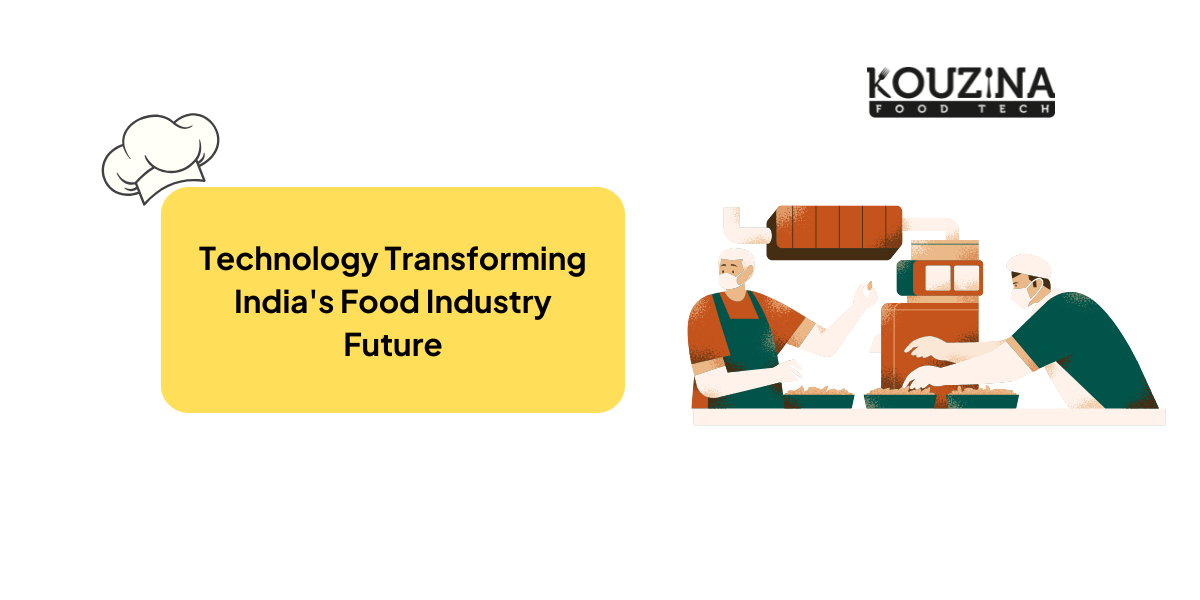
Automation and robotics are revolutionizing food processing by streamlining operations, reducing labor costs, & ensuring product safety and quality.
Aside from automation, various processing techniques are increasing shelf life and nutritional content.
This method preserves the nutritional quality, flavor, and texture of food products. It extends the shelf life of perishable items, such as juices and ready-to-eat meals.
It offers possibilities for complex shapes and textures. It also allows for precise control over portion sizes and ingredient composition, catering to tailored dietary needs.
Must read: Starting a Profitable Food Business: Ideas and Guide
The integration of technology is profoundly impacting India's food industry in several critical areas.
Technological advancements in food processing drive growth, increasing output and value. The PLISFPI scheme aims to create job opportunities, particularly in tech-related roles. While automation reduces the need for some manual jobs, it boosts demand for skilled labor and benefits ancillary industries such as packaging and logistics.
AI-powered tools detect contaminants, and blockchain ensures traceability from farm to table. Smart packaging provides real-time data on product freshness. These innovations improve food safety and consumer confidence. The FSSAI is adopting digital tools to enhance food safety management.
Technology fosters sustainable practices. Precision agriculture, utilizing AI and IoT, reduces water, fertilizer, and pesticide use. AI also predicts demand to reduce food waste. Renewable energy powers food production, while biodegradable packaging cuts environmental impact, supporting global sustainability goals.
While technological transformation in India's food industry is promising, challenges remain. Addressing these will be crucial for unlocking the sector's full potential.
For example, Kouzina focuses on developing strong partnerships with its franchisees to ensure they receive the necessary support at every stage of their entrepreneurial journey. Whether you're just starting or looking to expand, Kouzina provides the guidance and resources you need for success.
The trajectory for India's food industry is clear: technology will remain its primary catalyst for growth. Expect further advancements in:
India is well-placed to emerge as a global chief in AI-driven food innovation. The integration of technology across agriculture, production, retail, and delivery will propel India towards a smarter, healthier, and more sustainable food future.
Technology is reshaping India's food industry. AI and IoT are improving farm efficiency, while blockchain enhances food safety. This transformation addresses challenges such as food waste and fragmented supply chains, driving growth, exports, and sustainability.
Despite challenges like infrastructure gaps and skilled labor shortages, efforts from government, industry, and academia are paving the way. India’s focus on technology will create a more resilient, efficient, and competitive food sector.
If you want to enter this booming sector as a food business, Kouzina Food Tech provides a modern cloud kitchen model that mixes tradition with innovation.
Explore opportunities to bring the best of Indian fast food to a broader audience by visiting Kouzina Food Tech.
Become a franchise today!
What is food industry technology in India?
It encompasses technologies such as AI, IoT, and automation that enhance food production, safety, efficiency, and sustainability in India’s food sector.
How does AI impact food production in India?
AI optimizes crop yields, predicts planting times, and detects diseases, improving farming efficiency and reducing waste.
How does IoT improve food safety and traceability?
IoT uses sensors to monitor temperature and humidity, ensuring food safety during transportation and storage.
What role does blockchain play in the food industry?
Blockchain provides transparency and traceability, ensuring food quality and verifying product authenticity.
How does automation benefit food processing and packaging in India?
Automation boosts productivity, reduces labor costs, and improves consistency in food processing and packaging.