The Indian food industry is evolving at an unprecedented pace. Over the last decade, technology, changing customer behavior, increasing urbanization, and the rapid rise of food delivery platforms have transformed how people consume food. What once depended heavily on physical dining spaces is now increasingly driven by digital platforms and delivery-first models.
For aspiring food entrepreneurs, this shift raises an important and strategic question:
Cloud Kitchen Business Opportunity vs Traditional Restaurant — Which is Better?
This is not merely a comparison between two business formats. It represents a comparison between two fundamentally different philosophies. One is asset-heavy, experience-driven, and location-dependent. The other is asset-light, technology-enabled, data-driven, and built for rapid scalability.
Companies like Kouzina FoodTech have accelerated this transformation by building multi-brand cloud kitchen ecosystems that help entrepreneurs enter the food business with lower risk and structured operational support.
In this comprehensive guide, we will analyze investment requirements, operational structure, scalability, profitability, risk exposure, break-even timelines, long-term sustainability, and future growth potential to help you make a well-informed decision.
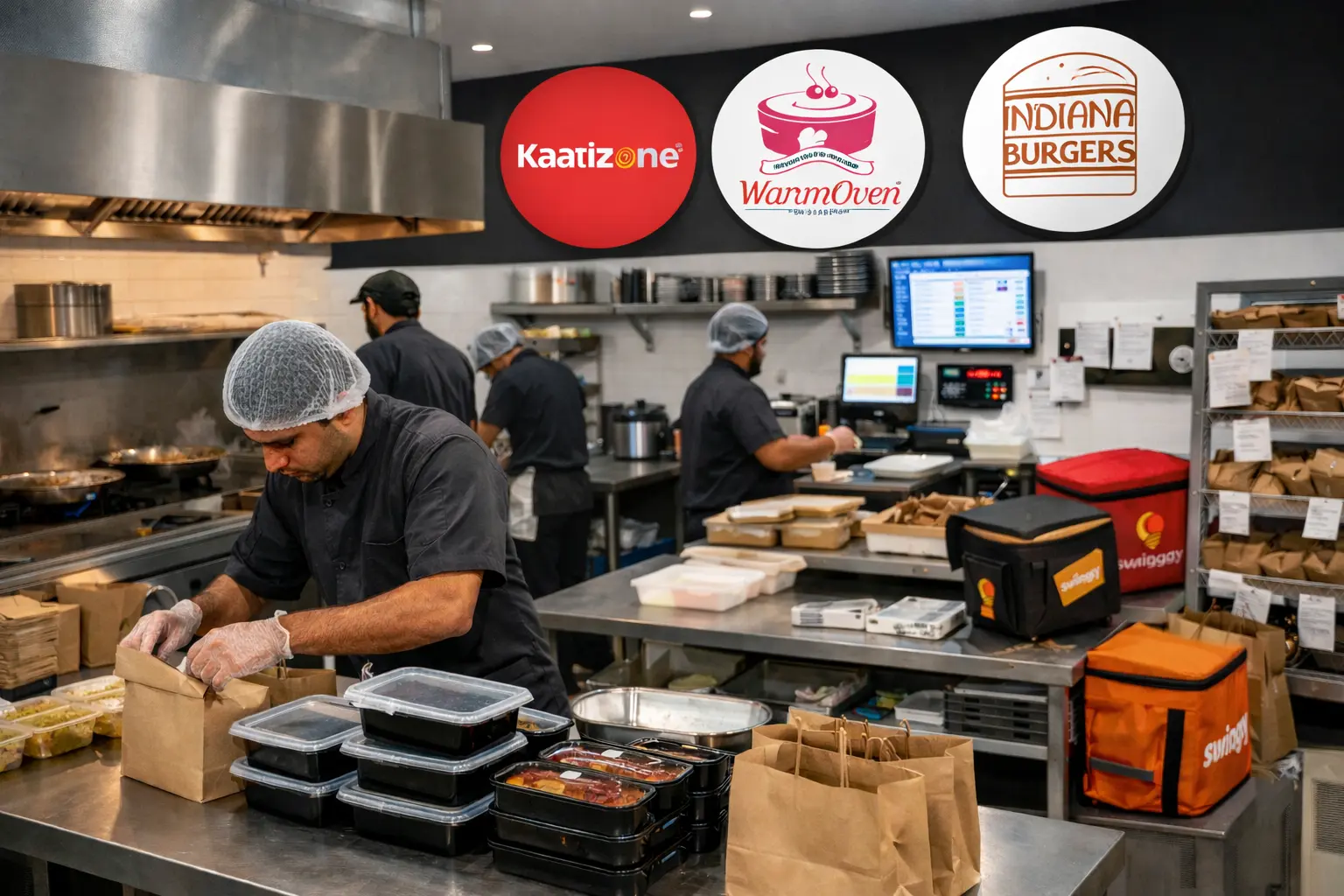
A cloud kitchen, also referred to as a virtual kitchen or ghost kitchen, is a delivery-only food business that operates without a dine-in facility. Orders are received through online platforms such as Zomato and Swiggy, prepared in a centralized kitchen, and delivered directly to customers.
The core philosophy behind a cloud kitchen is operational efficiency and cost optimization. Since there is no need for expensive high-footfall real estate, elaborate interiors, or front-of-house staff, the business can focus entirely on food production, packaging quality, and delivery optimization.
This model gained significant momentum post-2020 when consumer preferences shifted toward convenience, hygiene, and contactless dining. However, its growth was already supported by increasing smartphone penetration, digital payments, and the expansion of hyperlocal delivery networks across India.
Cloud kitchens are not simply smaller restaurants. They are tech-enabled food production units built around data analytics, demand forecasting, inventory control systems, and centralized supply chains.
Organizations like Kouzina FoodTech operate multi-brand cloud kitchen models where a single infrastructure supports multiple cuisines and brands, maximizing asset utilization and reducing business risk for partners.
Traditional restaurants represent the classic food service format. They combine kitchen operations with dine-in facilities and emphasize ambience, decor, hospitality, and customer experience.
Revenue streams in traditional restaurants typically include dine-in sales, beverages, takeaway orders, and online delivery. However, unlike cloud kitchens, these businesses depend heavily on physical footfall.
Location becomes the single most decisive factor. Restaurants prefer high streets, malls, and commercial hubs — areas that come with high rental costs and long lease commitments.
The traditional restaurant model focuses on creating an emotional and experiential connection with customers. Interior design, music, seating comfort, lighting, and staff service all influence brand perception.
While this approach can build strong customer loyalty, it also introduces significant capital intensity and operational complexity.
One of the most important factors in evaluating the Cloud Kitchen Business Opportunity vs Traditional Restaurant debate is initial investment.
A cloud kitchen requires investment in:
Since there is no need for premium retail real estate or elaborate interior design, the investment remains relatively controlled.
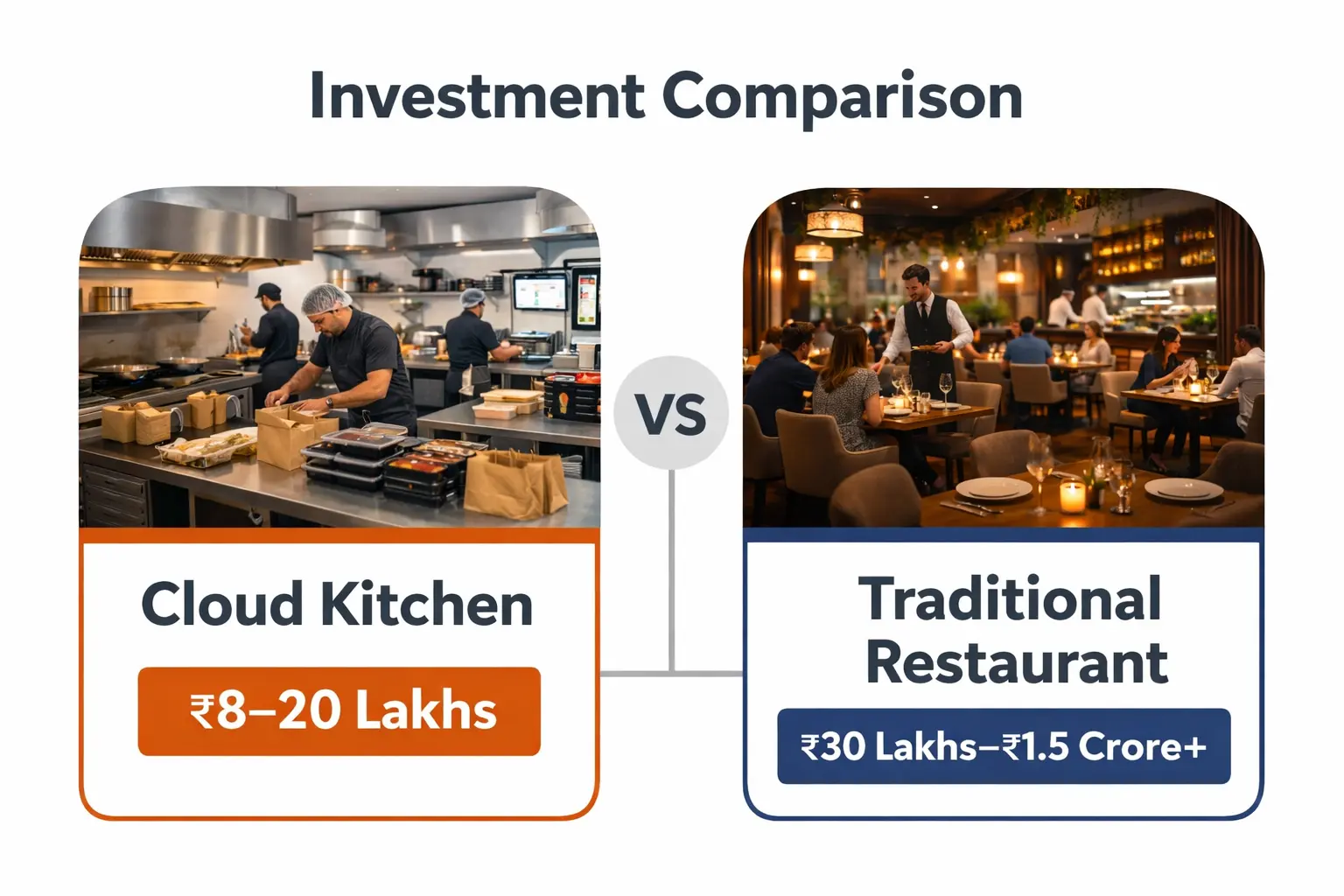
In India, a professionally managed cloud kitchen can typically be started between ₹8 lakhs and ₹20 lakhs, depending on scale and city.
With structured support from companies like Kouzina FoodTech, entrepreneurs also benefit from:
This significantly reduces the trial-and-error phase for first-time entrepreneurs.
Traditional restaurants require investment in:
In metro cities, total investment can range from ₹30 lakhs to ₹1.5 crore or more.
The capital intensity immediately increases financial risk and extends the break-even timeline.
Traditional restaurants depend heavily on visibility and footfall. Prime locations come with high rental costs and multi-year lock-in agreements. Monthly rent in metropolitan cities can run into several lakhs.
Cloud kitchens operate differently. Since customers never visit the location, the kitchen can function from cost-efficient commercial or semi-industrial areas.
The focus shifts from “walk-in traffic” to “delivery radius optimization.”
Lower rental costs reduce fixed overheads and improve profit margins — especially during seasonal slowdowns.
Traditional restaurants require chefs, waiters, cleaning staff, managers, and cashiers. Managing a large hospitality workforce increases salary expenses and operational coordination challenges.
Cloud kitchens operate with lean teams. There is no dine-in service, which eliminates waitstaff requirements. Automation tools handle billing, order tracking, and inventory management.
Structured cloud kitchen operators like Kouzina FoodTech also provide:
This data-driven ecosystem enhances efficiency and reduces operational complexity.
Traditional restaurants can generate strong revenue, especially from beverages. However, after deducting rent, salaries, utilities, maintenance, and marketing, net margins may shrink.
Cloud kitchens typically operate with lower fixed costs, allowing better margin control.
For example, multi-brand cloud kitchen operators like Rebel Foods have demonstrated the scalability of the model by running multiple food brands from a single kitchen infrastructure.
Similarly, structured multi-brand ecosystems such as Kouzina FoodTech help entrepreneurs maximize asset utilization and diversify revenue streams from a single kitchen setup.
Menu testing, pricing experiments, and performance analytics further enable continuous profit optimization.
Scalability is where cloud kitchens outperform traditional restaurants.
Opening a new cloud kitchen does not require elaborate interiors or customer-facing investments. Expansion is faster and capital-efficient.
With a technology backbone and standardized operations, organizations like Kouzina FoodTech enable partners to scale across multiple cities without replicating heavy infrastructure costs.
In contrast, expanding a traditional restaurant requires recreating the entire setup — décor, staff, marketing campaigns, and long-term lease agreements.
This makes expansion slower and riskier.
Urban professionals, students, and families increasingly prefer online food ordering due to convenience and time efficiency.
Delivery-first brands such as FreshMenu capitalized early on this trend by focusing on digital ordering models.
Food aggregators and improved last-mile logistics have normalized online food consumption as a daily habit.
This structural shift strongly supports the cloud kitchen business opportunity.
Both models carry risk, but their risk profiles differ.
Cloud kitchens:
However, their lower fixed costs provide flexibility during slow periods.
Traditional restaurants:
The asset-light structure of cloud kitchens provides greater financial resilience.
Cloud kitchens typically achieve break-even within 6 to 12 months, depending on execution and location.
Traditional restaurants may take 18 to 36 months due to higher investment and overheads.
Faster break-even reduces financial pressure and enables reinvestment.
Cloud kitchens are inherently adaptable because they operate on data. Menu changes, price optimization, and marketing experiments can be executed quickly.
Traditional restaurants offer experiential brand value, but structural rigidity may limit rapid adaptation.
Given evolving consumer behavior, digital infrastructure growth, and increasing urbanization, the cloud kitchen business opportunity appears more aligned with future market dynamics.
When evaluating Cloud Kitchen Business Opportunity vs Traditional Restaurant, the better choice depends on:
If your goal is:
Then partnering with an established ecosystem like Kouzina FoodTech makes the cloud kitchen business opportunity a highly compelling and future-ready model.
If your vision revolves around creating a physical dining experience and lifestyle brand, then a traditional restaurant may align better with your long-term aspirations.
However, in today’s digitally driven food economy, cloud kitchens represent the more scalable, capital-efficient, and growth-oriented opportunity for modern entrepreneurs.