
The Indian food industry is undergoing a massive transformation, driven by rapid urbanization, increasing digital adoption, and the explosive growth of food delivery platforms. Entrepreneurs entering the food business today are no longer limited to traditional restaurant models. Instead, they now have access to innovative formats like cloud kitchens, which are reshaping how food businesses operate and scale. This shift has made the debate around cloud kitchen vs restaurant in India more relevant than ever before.
In 2026, the decision between starting a cloud kitchen or a traditional restaurant is not just about preference—it is about profitability, scalability, and long-term sustainability. While restaurants have historically dominated the food service industry by offering dine-in experiences, cloud kitchens are emerging as a powerful alternative with significantly lower investment requirements and higher operational efficiency.
In this comprehensive guide, we will explore every aspect of the cloud kitchen vs restaurant India comparison, including investment costs, profit margins, scalability, risks, and future trends, while also highlighting how Kouzina Food Tech is enabling entrepreneurs to succeed in this rapidly evolving landscape.
A cloud kitchen, often referred to as a ghost kitchen or virtual kitchen, is a delivery-only food business model that operates without a physical dine-in space. Unlike traditional restaurants, cloud kitchens focus entirely on fulfilling online orders received through platforms like Swiggy and Zomato. This model eliminates the need for expensive real estate and front-end infrastructure, making it significantly more cost-effective.
What makes cloud kitchens particularly attractive in India is their flexibility. Entrepreneurs can run multiple brands from a single kitchen, experiment with different cuisines, and quickly adapt to changing consumer preferences without incurring major costs. This agility gives cloud kitchens a distinct advantage in a competitive and fast-moving market.
More importantly, companies like Kouzina Food Tech have simplified the process of starting a cloud kitchen by offering end-to-end solutions, including kitchen infrastructure, brand partnerships, and operational support. This has lowered the entry barrier for aspiring food entrepreneurs who want to build a profitable business without the complexities of running a traditional restaurant.

Traditional restaurants, on the other hand, are built around the dine-in experience. They require a physical space where customers can visit, enjoy meals, and interact with the brand. Restaurants focus not only on food quality but also on ambience, service, and overall customer experience.
While restaurants offer strong brand visibility and customer engagement, they come with significantly higher costs. From renting prime locations to designing interiors and hiring service staff, the initial investment can be substantial. Additionally, ongoing operational costs such as utilities, maintenance, and staffing can impact overall profitability.
Despite these challenges, restaurants still hold a strong position in the Indian market, especially in segments like fine dining and casual dining. However, when comparing cloud kitchen vs restaurant in India, it becomes clear that restaurants are facing increasing competition from more agile and cost-efficient cloud kitchen models.
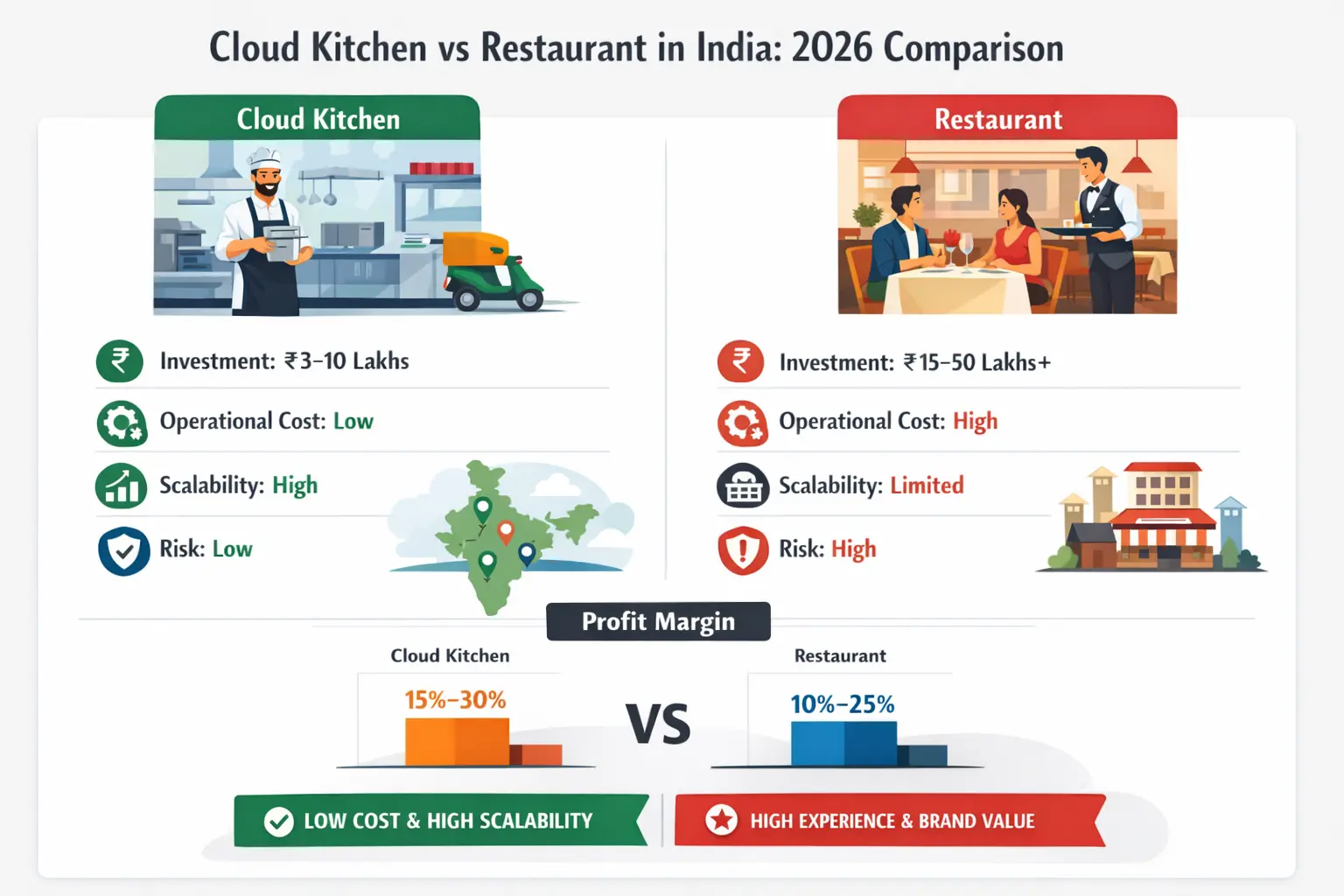
One of the most critical factors for any entrepreneur is the initial investment required to start a business. In this regard, cloud kitchens have a clear advantage. Setting up a cloud kitchen in India typically requires an investment of around ₹3–10 lakhs, depending on the scale and location. Since there is no need for a dine-in area, entrepreneurs can save significantly on rent, interiors, and furniture.
In contrast, opening a traditional restaurant can require an investment ranging from ₹15–50 lakhs or even more. The cost of securing a prime location, designing an attractive interior, and purchasing furniture and equipment can quickly add up. This makes restaurants a much riskier option, especially for first-time entrepreneurs.
This is where Kouzina Food Tech stands out as a game-changer. By providing ready-to-use kitchen infrastructure and established food brands, Kouzina allows entrepreneurs to start their cloud kitchen business with minimal investment and reduced risk, making it one of the most accessible entry points into the food industry.
Operational efficiency is another key factor that differentiates cloud kitchens from traditional restaurants. Cloud kitchens operate with a lean team, focusing primarily on food preparation and delivery. There is no need for waitstaff, front desk personnel, or large cleaning teams, which significantly reduces labor costs.
Restaurants, on the other hand, require a full team, including chefs, waiters, managers, and housekeeping staff. Additionally, they incur higher electricity and maintenance costs due to larger spaces and customer-facing operations. These expenses can reduce overall profit margins and make it harder to achieve consistent profitability.
With the support of Kouzina Food Tech, cloud kitchen operators can further optimize their operations through standardized processes, centralized supply chains, and data-driven insights. This level of efficiency is difficult to achieve in traditional restaurant setups.
When analyzing profitability, both models have their strengths. Cloud kitchens typically operate with profit margins ranging from 15% to 30%, depending on order volume and cost control. However, commissions charged by food delivery platforms can impact net earnings.
Restaurants, on the other hand, may have slightly lower margins due to higher overhead costs, but they can generate additional revenue through dine-in customers, upselling, and premium pricing.
That said, the scalability of cloud kitchens often leads to higher overall profits in the long run. By operating multiple brands from a single kitchen and expanding into new locations quickly, entrepreneurs can significantly increase their revenue potential.
Kouzina Food Tech plays a crucial role here by enabling entrepreneurs to run multiple high-demand food brands from a single kitchen, maximizing revenue without increasing operational complexity. This multi-brand strategy is one of the key reasons why cloud kitchens are becoming more profitable than traditional restaurants in India.
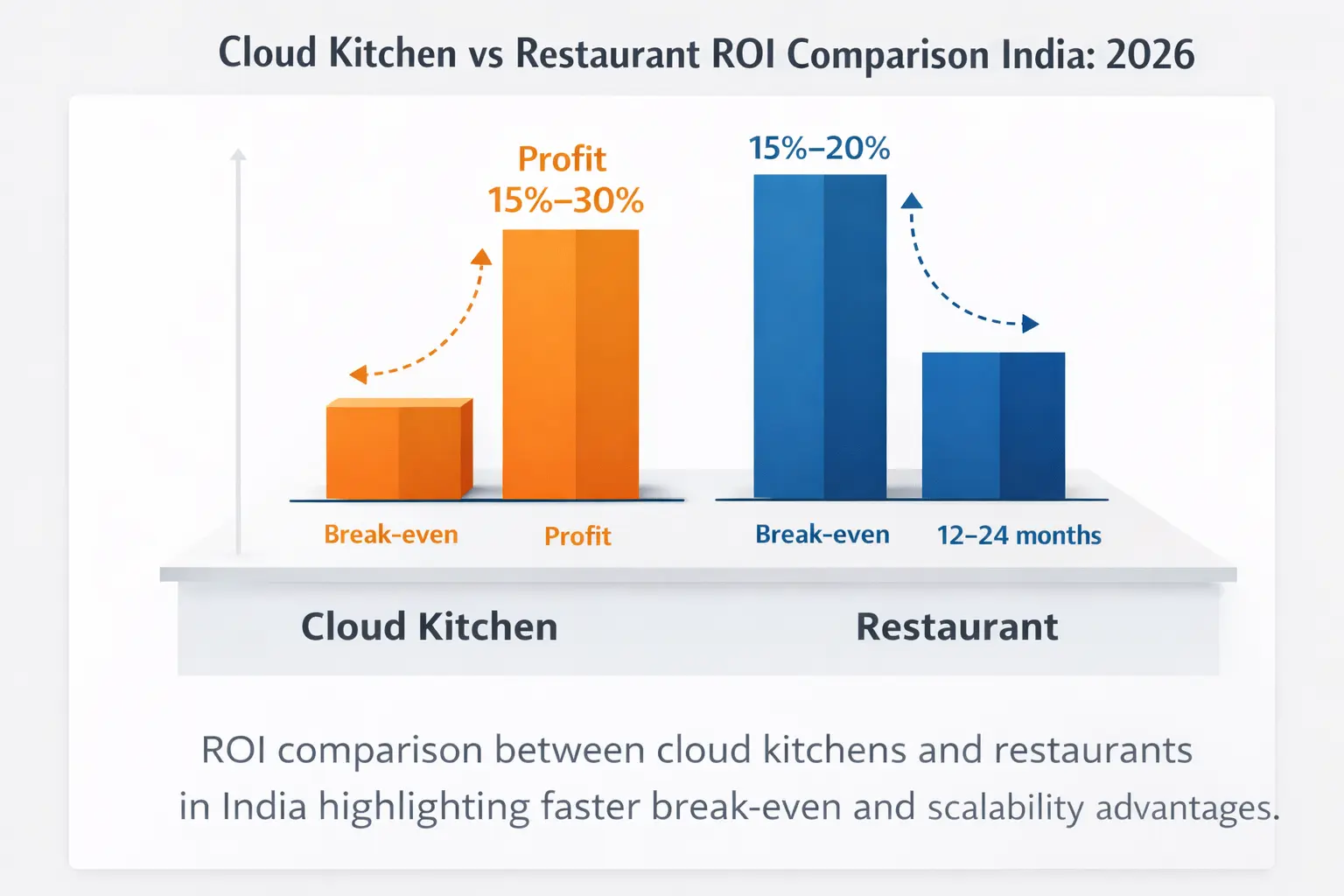
Scalability is where cloud kitchens truly outperform traditional restaurants. Expanding a restaurant requires significant investment, time, and effort, as each new outlet needs to be set up from scratch. This makes growth slower and more capital-intensive.
Cloud kitchens, in contrast, can scale rapidly by replicating their model across multiple locations. Entrepreneurs can launch new brands, enter new markets, and increase their reach without heavy investment.
With Kouzina Food Tech, scaling becomes even easier. The platform provides access to multiple established brands, operational support, and a proven business model, allowing entrepreneurs to expand their business quickly and efficiently.
While cloud kitchens excel in efficiency and scalability, restaurants have an advantage when it comes to customer experience. The ambience, service, and personal interaction offered by restaurants create a strong emotional connection with customers, which can lead to higher loyalty.
However, cloud kitchens are catching up by focusing on food quality, packaging, and digital branding. With the right strategy, cloud kitchen brands can build strong customer relationships even without a physical presence.
Kouzina Food Tech helps bridge this gap by offering well-established brands that already have strong customer recognition, making it easier for entrepreneurs to build trust and attract repeat customers.
Risk is an important consideration when choosing a business model. Restaurants involve high financial risk due to large upfront investments and ongoing expenses. If the business does not perform well, recovering the investment can be challenging.
Cloud kitchens, on the other hand, involve lower financial risk and offer greater flexibility. Entrepreneurs can easily modify their menu, switch brands, or even shut down operations with minimal losses.
By partnering with Kouzina Food Tech, entrepreneurs can further reduce risk by leveraging a proven business model and receiving continuous support, making it easier to navigate challenges and achieve success.
The future of the Indian food industry is being shaped by convenience, technology, and changing consumer preferences. As more people prefer ordering food online rather than dining out, cloud kitchens are becoming the preferred choice for both consumers and entrepreneurs.
The ability to operate multiple brands, optimize costs, and scale quickly makes cloud kitchens a highly attractive business model. With the support of platforms like Kouzina Food Tech, this model is becoming even more accessible and profitable.
Kouzina Food Tech is at the forefront of the cloud kitchen revolution in India. By offering a complete ecosystem for food entrepreneurs, Kouzina simplifies every aspect of starting and running a cloud kitchen business.
From providing ready kitchen infrastructure to offering access to multiple popular food brands, Kouzina enables entrepreneurs to focus on operations and growth rather than setup challenges. This unique approach has made Kouzina one of the most trusted platforms for launching and scaling cloud kitchens in India.
If you are looking to start a profitable food business with low investment and high growth potential, partnering with Kouzina can give you a significant advantage in today’s competitive market.
When comparing cloud kitchen vs restaurant in India, it is clear that cloud kitchens offer a more profitable and scalable business model in 2026. While restaurants continue to play an important role in the industry, the lower costs, higher efficiency, and rapid scalability of cloud kitchens make them the preferred choice for modern entrepreneurs.
With strong industry support from platforms like Kouzina Food Tech, starting a cloud kitchen has never been easier or more rewarding.
Choosing between a cloud kitchen and a restaurant ultimately depends on your business goals, budget, and risk tolerance. However, given the current market trends and growth opportunities, cloud kitchens are clearly leading the future of the food industry in India.
If your goal is to build a scalable, profitable, and future-ready food business, then a cloud kitchen—especially with the support of Kouzina Food Tech is the smartest choice you can make in 2026.


